

09 · Expert · Professional
Integration & Application — From Analysis to Development
Read the green and the roasted coffee; develop it through roasting and brewing
Written by Chanho Hong
What this chapter covers
Quantitative and qualitative analysis of green and roasted coffee, the give-and-take between roasting and brewing, and the conditions that make flavour and texture better — brought together into one working sequence.
The core of the expert level is to combine measurable analysis (quantitative) with sensory judgement (qualitative) and, moving back and forth between roasting and brewing, to develop flavour and texture deliberately. The knowledge of the preceding chapters is integrated into a single workflow.
Green Coffee Analysis — Quantitative · Qualitative
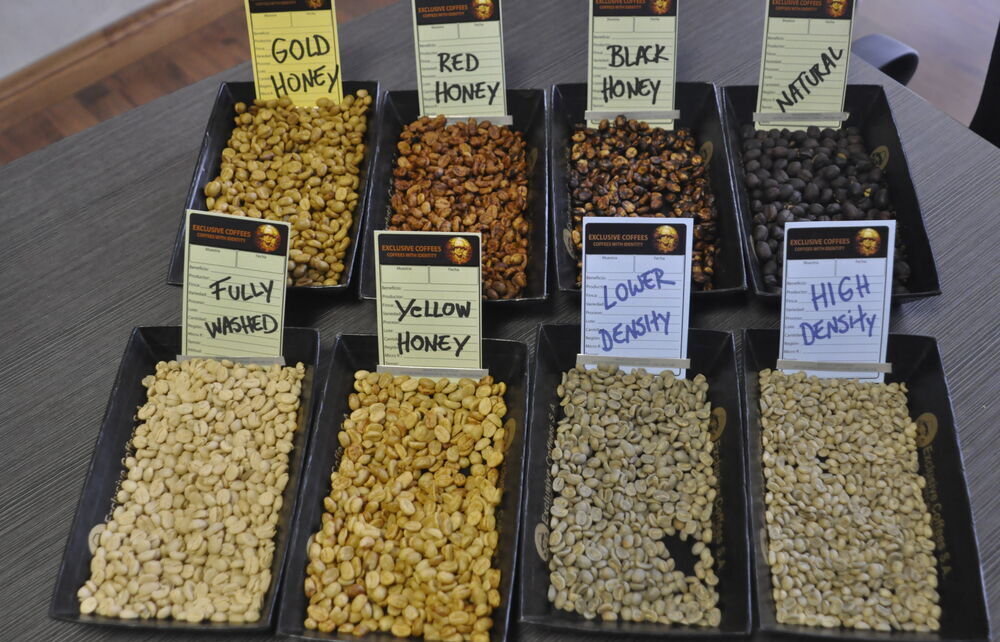
Green coffee analysis looks at the physical properties that can be measured (quantitative) and the characteristics read through the senses and the appearance (qualitative) together. The two axes meet to fix the starting point of the roasting profile.
| Quantitative | Meaning · use |
|---|---|
| Moisture content (Moisture, 10–12%) | High means drying and storage risk, and more energy needed early in the roast |
| Water activity (Water Activity, aW ~0.55 or below) | Indicator of storage stability and fermentation risk |
| Density (Density) | High density tends to mean high altitude; more energy and time needed |
| Screen size (green bean size) | Sorting criterion for an even roast |
| Defects (350 g sample) | Specialty = Primary 0 · Full ≤5 |
Colour, form, smell (green smell: grass, hay, fermentation), uniformity, and visual inspection for parchment and defects. And cupping after a sample roast is the final qualitative assessment — it confirms the latent flavour of the origin, variety and processing.
The quantitative tells you how to roast (density and moisture → energy); the qualitative tells you what to aim for (flavour potential). Know the density but skip the cupping and you know how to roast it without knowing where to take it.
① The quantitative dictates the "how". If a new lot is 12.5% moisture and high density, the roasting method follows: "more energy in the early drying, and generous time to first crack".
② The qualitative dictates the "what". If sample cupping shows latent berry and wine acidity, the direction is set: "let us bring that acidity out with filter and a light roast". The two axes combine so that the direction and the method of the profile are decided at the same time.
③ Judgements about storage and supply. High water activity (aW) means a large risk of fermentation and mould in storage, so schedule the lot to be used up quickly or tighten the storage conditions. Quantitative analysis guides not only roasting but inventory management as well.
Roasted Coffee Analysis — Quantitative · Qualitative
| Quantitative | Qualitative |
|---|---|
| Colour (Agtron, surface · core) | Cupping: acidity · sweetness · body · aftertaste · balance |
| Weight loss (Weight loss, 12–20%) | Descriptors (on the flavour wheel) |
| Development time / DTR | Presence of defects (baked · under · tipping) |
| Moisture content (target <5% after roasting) | Surface–core colour difference (judging internal development) |
| Extraction TDS · yield (reference recipe) | Suitability for the intended brewing use |
"It tastes good" cannot be reproduced. Only by pinning it down quantitatively — Agtron #62, DTR 19%, weight loss 15% — do you reproduce the same sensory result in the next batch. The qualitative (cupping) sets the target; the quantitative records the coordinates of that target.
① Fingerprinting a batch. Record a well-received batch quantitatively: "Agtron surface 61 / core 64 (colour difference 3) · DTR 18% · loss 14.8% · reference extraction TDS 1.38% / yield 20.5%". These coordinates become the standard for reproduction.
② Early detection of anomalies. If the next batch comes out at DTR 22% and colour difference 6, you can predict the risk of "over-development and an underdeveloped core" and adjust before cupping. The quantitative warns you before the senses do.
③ Verifying fitness for purpose. Re-measuring TDS and extraction yield with the reference recipe lets you judge numerically whether "this batch suits filter or espresso". The qualitative (cupping) records the target, the quantitative its coordinates, and together they turn chance into control.
Development Through Roasting and Brewing
Flavour and texture develop potentially in roasting and actually in brewing. The two give and take with each other, and the best cup comes when both are designed together.
Gives & Takes Between Roasting & Brewing
Roasting and brewing achieve the same goal at different costs. Trim the acidity in roasting (development↑) and brewing becomes easier; roast bright (light) and brewing has to avoid grassy notes with a more precise extraction. When one side carries the burden, the other side is lightened.
| Goal | By roasting | By brewing |
|---|---|---|
| Softening acidity | Development↑ · degree of roast↑ | Temperature↓ · longer ratio · adjust extraction yield |
| Sweetness↑ | Manage the caramelisation phase · appropriate DTR | Take extraction yield into the sweetness band (finer, hotter) |
| Body↑ | Degree of roast↑ · lipids brought to the surface | Finer · shorter ratio (TDS↑) · metal filter |
| Clean · transparent | Even roasting (colour difference↓) | Paper filter · even extraction · longer ratio |
Taste & Texture Balance Changes
Taste Balance moves chiefly with extraction yield (how far extraction has progressed), and the potential balance from roasting fixes its starting point. Texture is made jointly by the lipids and polysaccharides from roasting and by the fines, filter and strength from brewing. In other words, thinking of taste on the extraction-yield axis and texture on the particle · filter · strength axis makes control much clearer.
Good green coffee · appropriate development (no grassiness, no baking) · freshness (appropriate degassing) · appropriate extraction yield (each tool and coffee has its own baseline) · good water (appropriate hardness, low alkalinity) · even extraction (no channelling). The absence of defects is the first condition for good flavour.
Appropriate preservation of lipids and polysaccharides, even fines (avoiding excessive fines), filter choice (metal for body, paper for cleanness), appropriate strength (TDS), and avoiding the dryness and astringency caused by over-extraction. The target for texture is not "heavy" but "the weight you want, cleanly".
① Dividing the work for sweetness between roasting and brewing. For a "sweet, soft filter", give a generous DTR in roasting to build the sweetness potential, and in brewing take the extraction yield into the sweetness band while stopping just short of over-extraction. Both stages divide the work towards one goal.
② Separating texture as an axis. To leave the taste (extraction-yield axis) alone and add only texture, keep it clean with a paper V60 and, if that falls short, grind very slightly finer to raise the body alone. Move the taste axis and the texture axis separately.
③ Choosing where to soften the acidity. If the acidity is excessive, reduce the potential acid through roasting (development↑, degree of roast↑) or adjust it on the day through brewing (temperature↓, longer ratio). Attempt the same goal from the cheap level (brewing) first, and escalate to roasting if a fundamental fix is needed.
Questions this chapter answers
- What does quantitative analysis of green coffee actually measure?
- Measurable values: water content, density, screen size, water activity, defect count. These are what tell you how to roast — high water content means more energy is needed through the drying phase, high density means heat struggles to reach the core.
- Are flavour and texture controlled by the same levers?
- No. Taste is made mostly on the yield axis; texture is made on the particle, filter and strength axes. That is why states like 'good flavour but thin' or 'thick but hollow' exist, and each needs a different correction.
- What actually improves texture?
- Preserving lipids and polysaccharides appropriately, avoiding excessive fines, choosing the filter for the purpose (metal for body, paper for clarity), and keeping strength in the right range. The goal of texture is not 'heavy' but 'cleanly filled'.
Figures and regulations are verified against a source hierarchy: Tier 1 in-house knowledge base → Tier 2 SCA·WBC and peer-reviewed literature → Tier 3 web. Anything not adequately supported is marked [to verify] in the text.