

01 · Basic · Intermediate
Green Coffee — From Seed to Cup
Variety, cultivation, processing and trade — where the ceiling of a cup is set
Written by Chanho Hong
What this chapter covers
What actually separates Arabica, Canephora and Liberica; why microclimate changes acidity; how Washed, Natural, Honey and anaerobic processing work; and a worked calculation showing how the C market price becomes the price of a kilo of green coffee in Korea.
The coffee we drink is the seed of the coffee tree's fruit (the cherry), roasted and extracted. The quality of a cup is largely decided at the green coffee stage, before roasting and extraction ever begin. This chapter covers the four axes that make up green coffee — variety (what), cultivation (where and how), processing (by which method), and the market (through which channel).
Varieties — Arabica · Canephora · Liberica · Hybrid
Variety refers to a genetic branch of the coffee tree (genus Coffea). At species level it divides into Arabica, Canephora and Liberica, and within Arabica it divides again into cultivars — Typica, Bourbon, Geisha and so on. Variety sets the genetic baseline for acid, sugar, amino acid and chlorogenic acid content.
On the same farm with the same processing, a different variety gives a different character in the cup. Variety is "what was planted"; the cultivation (terroir) and processing that follow determine "how much of that genetic potential is drawn out". Remember this order and you gain an eye for reading origin information: genotype → (terroir + processing) → phenotype.
The three commercial species
| Species | Botanical name | Global share (approx.) | Caffeine (green, dry weight) | Character |
|---|---|---|---|---|
| Arabica Arabica | Coffea arabica | about 60% | 0.9 – 1.5% | Complex flavour, high acidity, grown at altitude (800 m+), susceptible to disease |
| Canephora (=Robusta) | Coffea canephora | about 37% | 1.7 – 4.0% | Heavy body, strong bitterness, viable at low altitude, higher disease resistance and yield |
| Liberica (incl. Excelsa) | C. liberica (var. dewevrei=Excelsa) | under 1% | variable | Large, irregularly shaped fruit; smoky, jackfruit and woody nuances; regional to the Philippines and West Africa |
In Arabica, the cherry ripens slowly at altitude and low temperature, accumulating more acid and sugar. That complexity is the source of the "transparent acidity, multi-layered flavour" specialty pursues. In exchange, it is an allotetraploid (2n=4x=44) with a narrow genetic base, which makes it sensitive to disease and temperature, so it is demanding to grow.
Canephora (Robusta) is high in caffeine and chlorogenic acid, which makes it resistant to pests and fungi and able to grow at low altitude. Caffeine contributes only about 10% of bitterness, but the high CGA and polysaccharide content tends to give it heavy body and strong bitterness. In espresso blends it is used to reinforce crema and body.
"Geisha is a Japanese variety" — false. Geisha is native to Ethiopia and is an Arabica variety that gained worldwide fame in Boquete, Panama. The name comes from the place name "Gesha" (the Gesha forest in Ethiopia) and has nothing to do with the Japanese 芸者.
"Robusta has half the caffeine of Arabica" — false. It has roughly twice as much.
Major cultivars within Arabica
| Variety | Lineage | Characteristics |
|---|---|---|
| Typica | Closest to the original type | Clean and balanced. Low productivity. Ancestor of the Latin American varieties. |
| Bourbon | Island (Réunion) mutation of Typica | Higher sweetness, fruit and complexity. Differentiated into Yellow/Red/Pink Bourbon. |
| Caturra | Natural mutation of Bourbon (Brazil) | Dwarf, suited to high-density planting, higher productivity. Bright acidity. |
| Catuai | Mundo Novo × Caturra | Yield and wind resistance. Balanced type. |
| SL28 / SL34 | Scott Labs selections (Kenya) | Blackcurrant, cassis, strong complex acidity. The signature of Kenya. |
| Geisha (Gesha) | Native to Ethiopia → Boquete, Panama | Jasmine, bergamot, peach, black tea. A regular in the highest-priced lots. |
| Pacamara | Pacas × Maragogipe (El Salvador) | Very large bean, complex and showy flavour. |
| Ethiopia Heirloom | Indigenous wild populations | A collection of thousands of genotypes. The source of floral and citrus notes. |
Hybrid — crosses and F1 hybrids
A hybrid is a variety created by crossing different varieties or species. The aim is usually to secure disease resistance (especially coffee leaf rust) and yield together with cup quality.
- Interspecific-cross origin — Catimor, Sarchimor and Castillo obtained rust resistance by crossing Arabica with Híbrido de Timor (a natural Arabica × Robusta hybrid). Early generations were held to have low cup quality, but there are many cases, such as Castillo, where quality was raised over successive generations.
- F1 hybrids — varieties bred by making a first-generation cross between two genetically distant parents to exploit heterosis (e.g. Centroamericano, Starmaya, Ruiru 11, Batian). Vigour, yield and cup quality are excellent, but F1 traits do not carry through seed, so tissue culture and clonal propagation are required and seedlings are expensive.
① An eye for reading menus and labels. In "Colombia Castillo, Washed", Castillo is a disease-resistant cross, which signals stable production for the farm; "Panama Geisha, Washed" is a high-value variety that is demanding to grow, so the price bracket and the flavour expectation (jasmine, bergamot) are completely different. A single variety name tells you about price, flavour and farm risk at once.
② Deciding the roast direction. From the same origin, if the variety is SL28 (Kenya, strong complex acidity) you aim light to medium to keep that acidity alive; if it is a Bourbon-line variety (tending sweet) you aim medium to bring up caramel and sweetness. The genetic baseline of the variety tells you first "what to bring forward".
③ Blend design. If an espresso blend needs reinforced body and crema, add a small proportion of Canephora (Robusta); if it needs a bright accent, blend in Ethiopia Heirloom. Knowing the traits of the species and variety (the caffeine, CGA, acid and sugar baselines) lets you fill the missing axis precisely.
Cultivation — Climate · Microclimate · Growing process
Terroir is the character particular to an origin, produced by the combination of soil, climate, altitude, humidity and sunlight. Climate refers to the broad weather conditions of the origin as a whole; microclimate refers to the local conditions of a specific farm or plot.
Climate — the coffee belt
Coffee is grown within roughly 25° north and south of the equator (the coffee belt). Arabica prefers an annual mean of 15–24℃, Robusta 24–30℃. Outside that band, frost (cold) or photosynthetic stress (heat) breaks down both quality and yield.
At higher altitude the temperature is lower and the cherry ripens slowly. The slower the ripening, the longer organic acids and sugars accumulate in the seed, and the denser the cells become, giving a hard, high-density bean. A dense bean takes heat differently in roasting and delivers a more defined acidity.
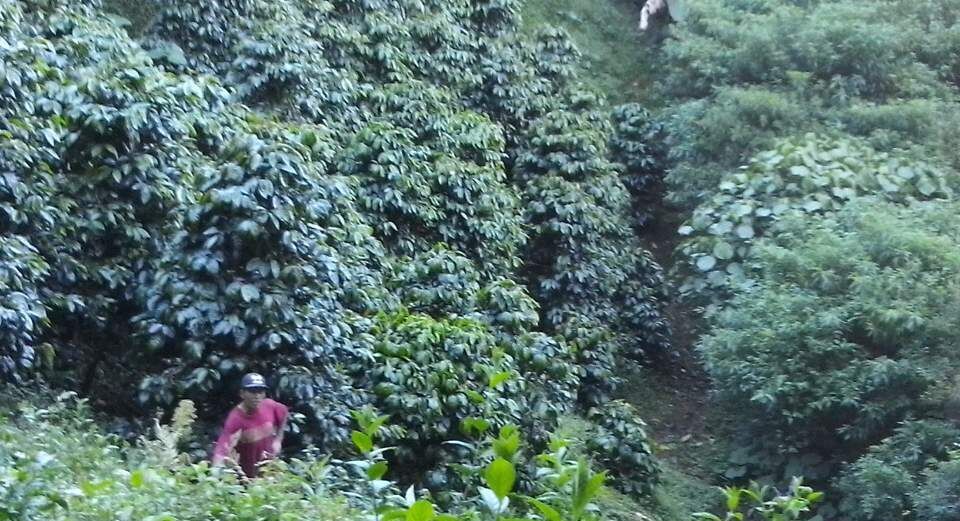
Even within one origin, slope aspect (sunlight), tree shade, moisture and wind differ from plot to plot. These local variables (the microclimate) change the rate of fermentation and ripening, so flavour diverges even between neighbouring fields. Shade-grown cultivation is the classic example of microclimate management: it softens direct sun, slows ripening and conserves the ecosystem.
The plantation process
- Nursery and planting out — seeds are raised in a nursery bed and transplanted to the field after 8–12 months. After planting it takes 3–4 years to the first harvest, with stable yields from year five.
- Crop management — shade trees, soil (nitrogen and organic matter), pruning, and pest and disease control. Shade trees simultaneously prevent soil erosion, fix nitrogen and moderate the microclimate.
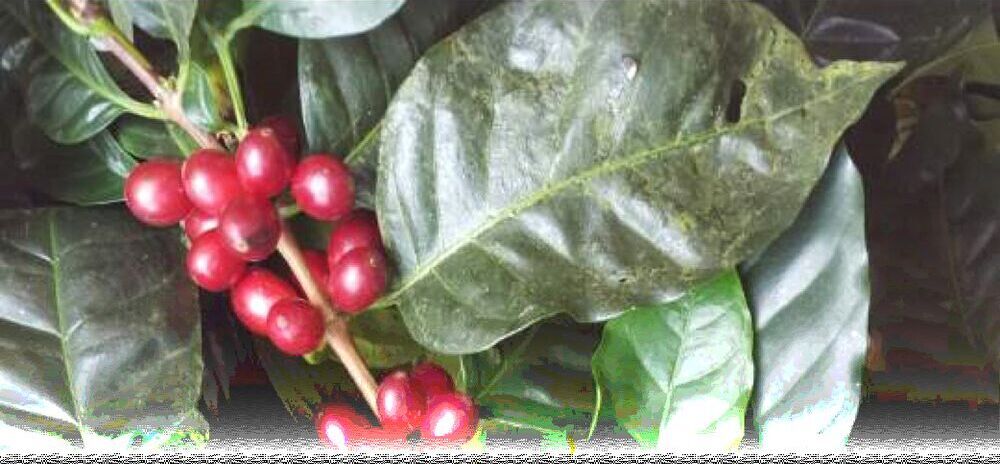
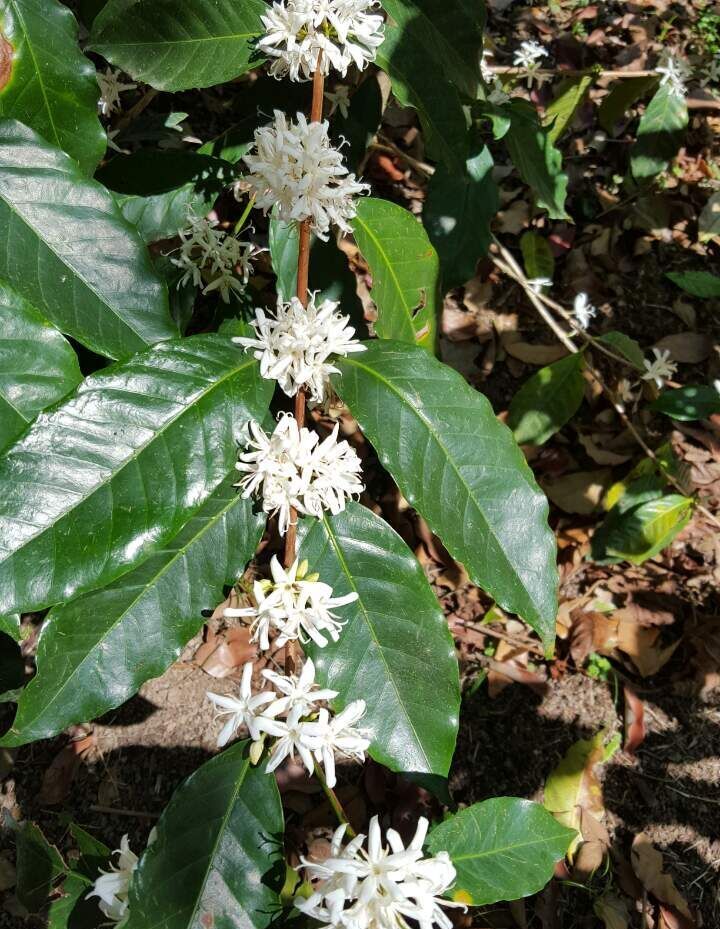
- Flowering and fruit set — flowering follows the rainy season, and the cherry ripens over 6–11 months. Latitude and rainfall pattern determine whether there are one or two harvests a year.
- Harvest — selective (hand) picking takes only ripe cherries and gives high quality, while strip or mechanical harvesting is fast but mixes in unripe and overripe fruit. Selective picking is the norm for specialty.
① Reading altitude and harvest information on a label. "Ethiopia Guji, 2,050 masl, hand-picked, shade-grown" — high altitude, hand harvesting and shade growing all point to slow ripening and high selectivity. Bright acidity and floral notes are expected, so a light to medium roast that preserves acidity is the right choice. For a low-altitude, strip-harvested lot it is safer to aim at body and chocolate rather than acidity.
② Same farm, different plot (microclimate). Even within one farm it is common for lots from north-facing, heavily shaded plots to show more defined acidity and slower ripening than lots from south-facing plots. If the roaster cups by plot (lot number) and fine-tunes the roast per plot, the best expression can be drawn from a single farm.
③ Sourcing decisions based on climate and crop. In a year when a particular origin had unstable drying due to abnormal rainfall, the defect risk in Natural lots rises. In that case you switch to Washed lots from the same origin, or secure an alternative plot at higher altitude, managing the variability of terroir at the sourcing stage.
Processing — Cherry structure and processing methods
Processing is the sequence of operations that separates the seed (green coffee) from the harvested cherry and dries it. When and how the mucilage is removed is what divides the processing methods, and that choice greatly changes the acidity, sweetness, body and cleanliness of the cup.
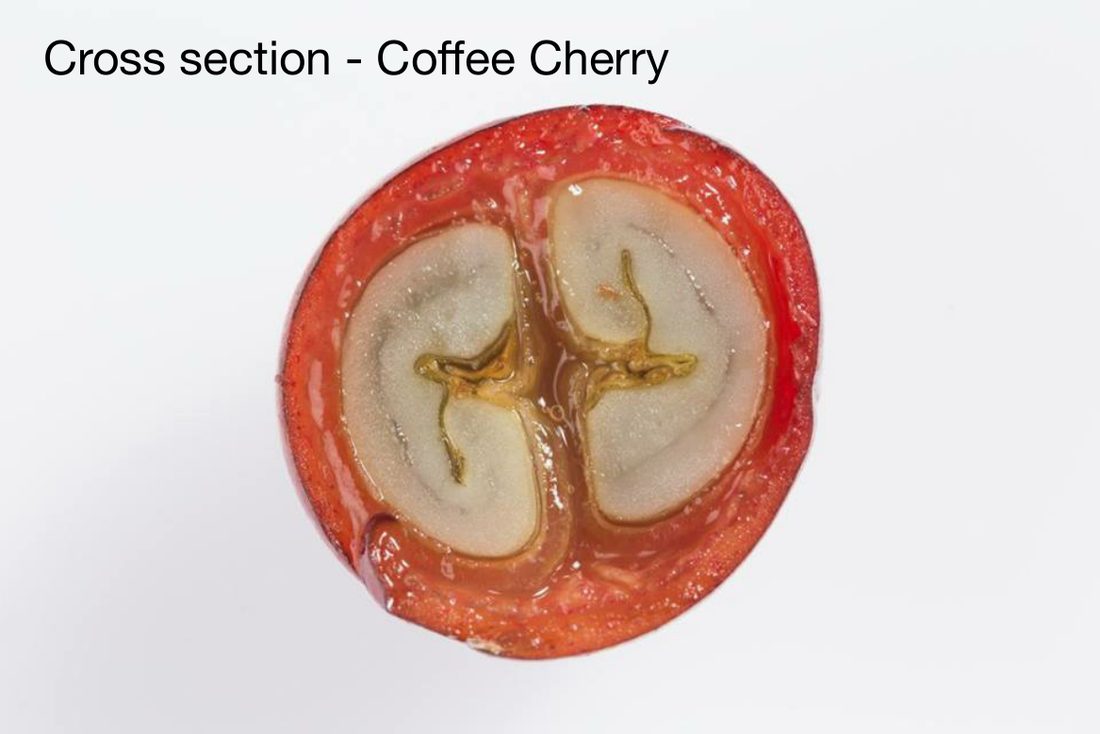
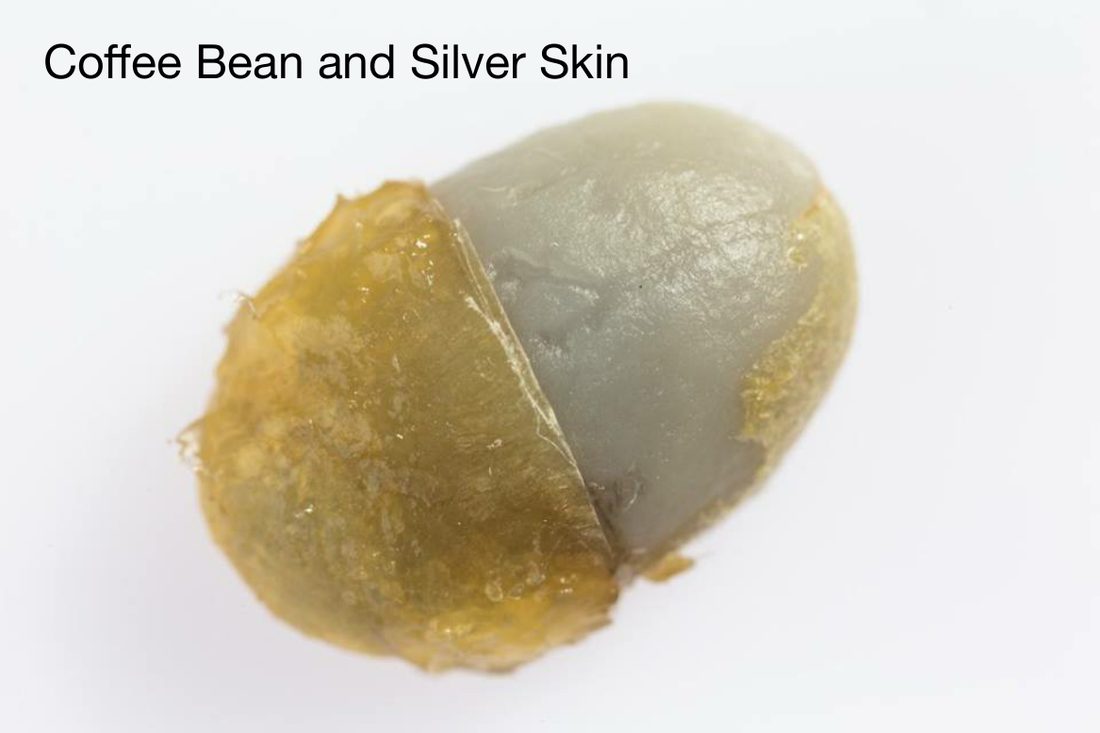
The structure of the coffee cherry
The sticky layer surrounding the seed, rich in sucrose and pectin. When and how much of this sugar is removed is the essence of a processing method. If the sugar penetrates the seed during fermentation and drying, sweetness and body rise; if it is washed off completely, the cup is clean and the acidity stands out.
The three classic processes
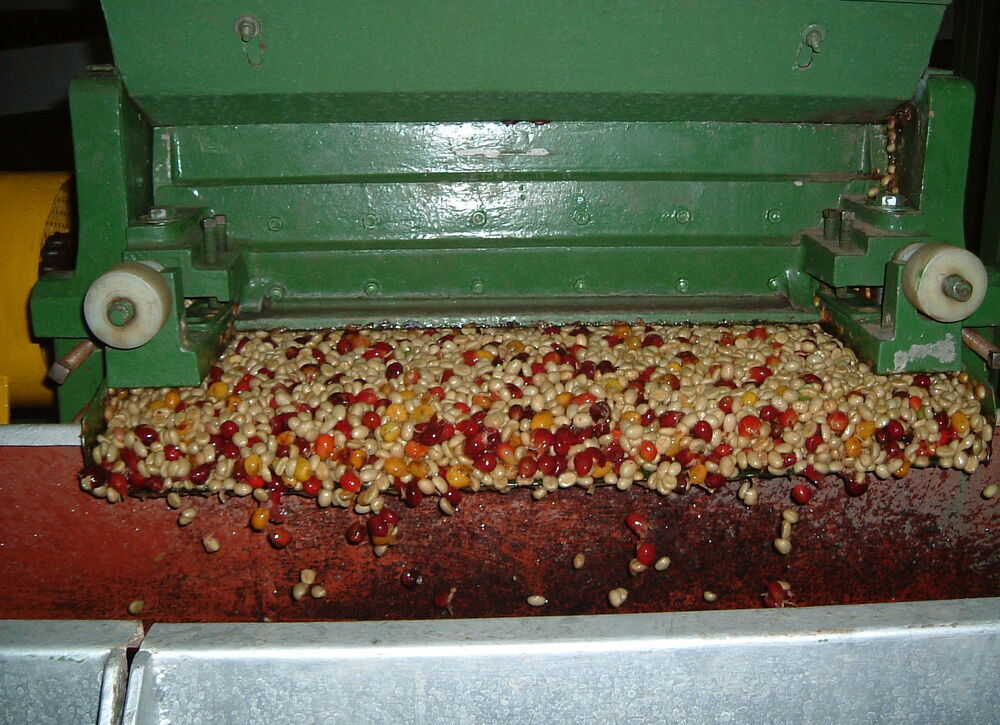
① Washed / Wet
The pulp is removed and the coffee is fermented in water for 12–48 hours to break down the mucilage, then washed clean and dried in parchment. Because fermentation strips away almost all the sugar, the character of origin and variety shows most transparently. Sensory: soft and clean, with a tidy sweetness and high acidity.
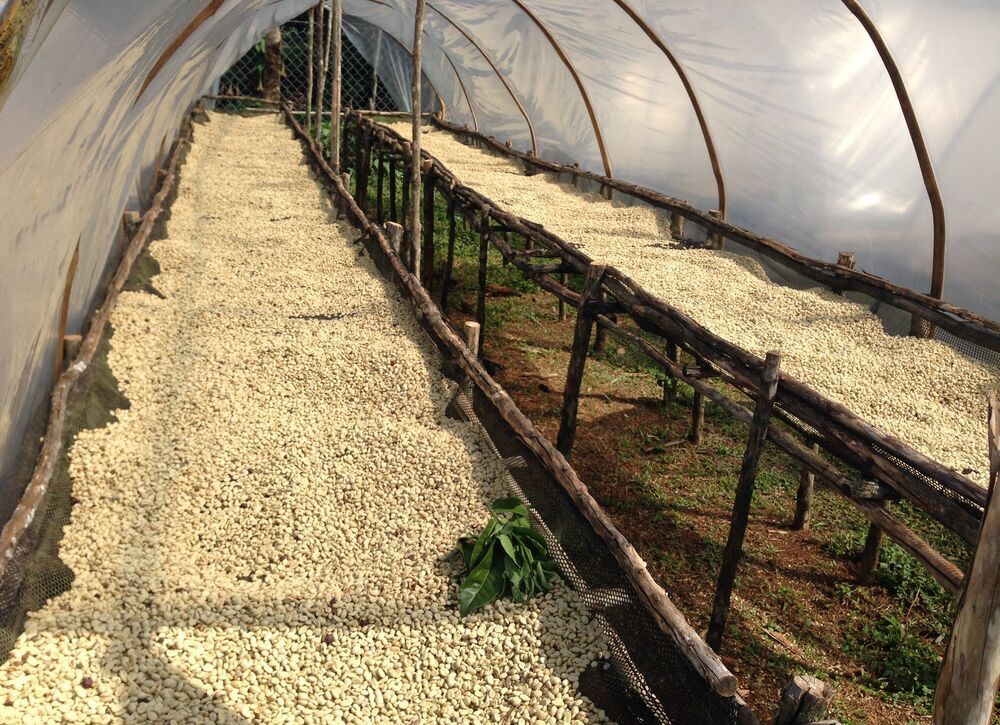
② Natural / Dry
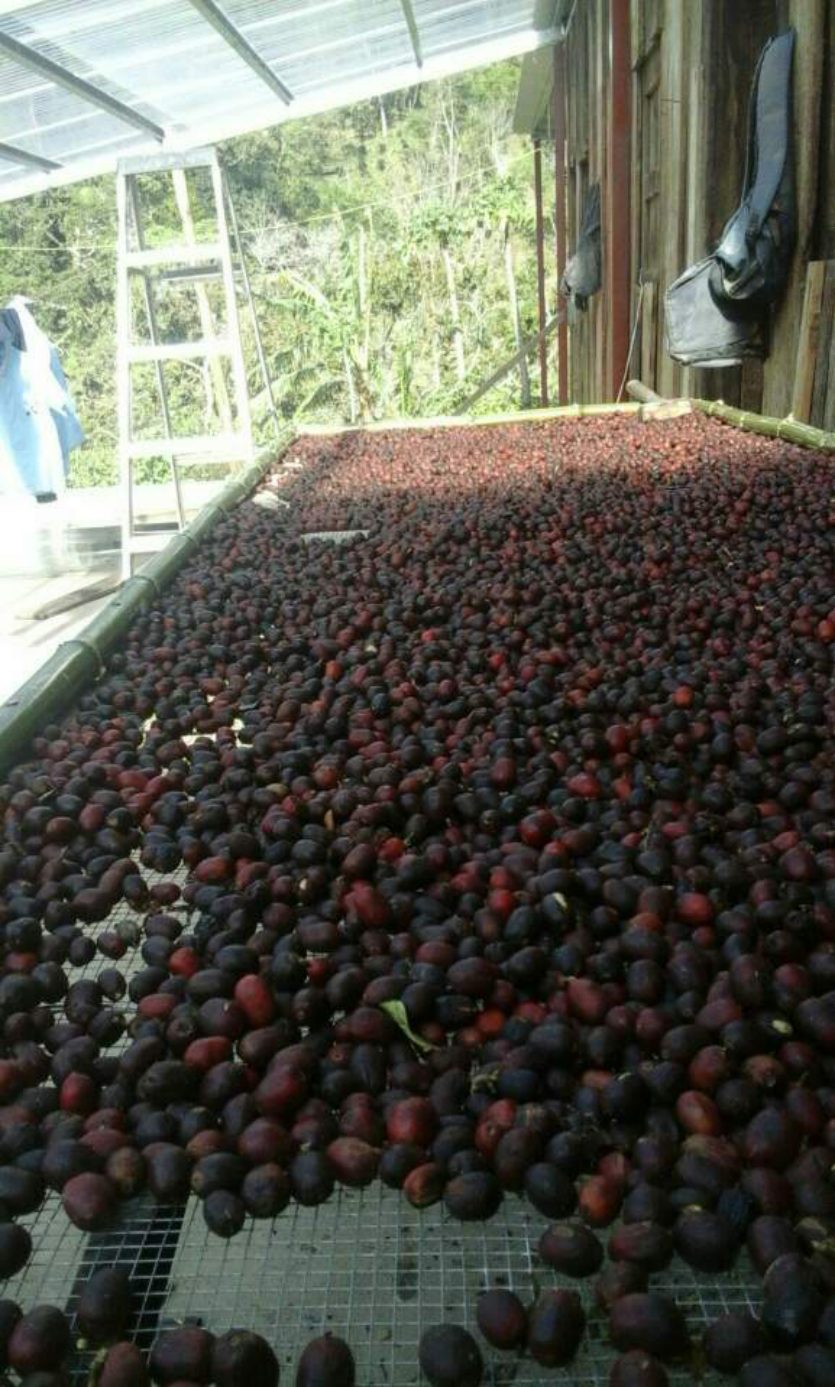
The whole cherry is dried on African beds or patios for 15–30 days and then dry-hulled. Sugar from the pulp permeates the seed, emphasising fruit aroma, sweetness and body, with wine- or rum-like fermentation nuances. In exchange, even drying is difficult and the defect risk is high.
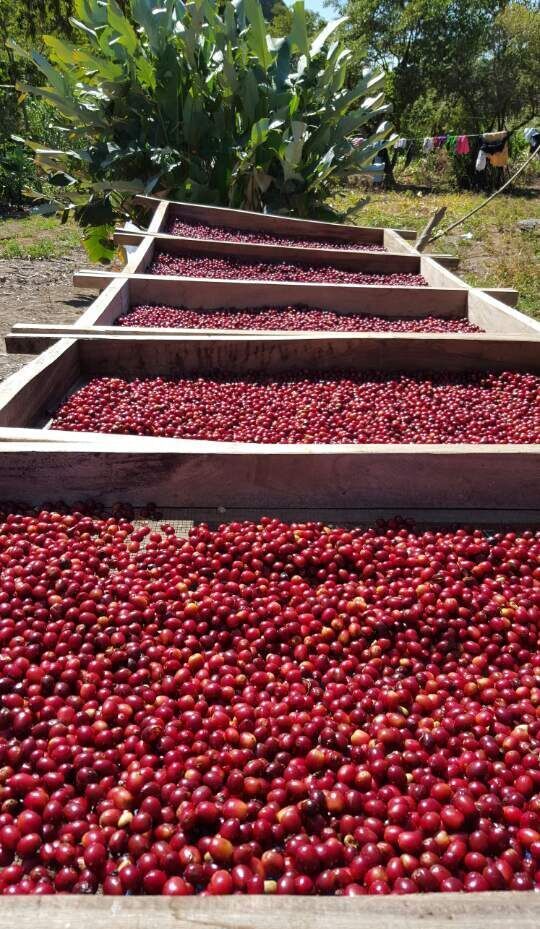
③ Honey / Pulped Natural
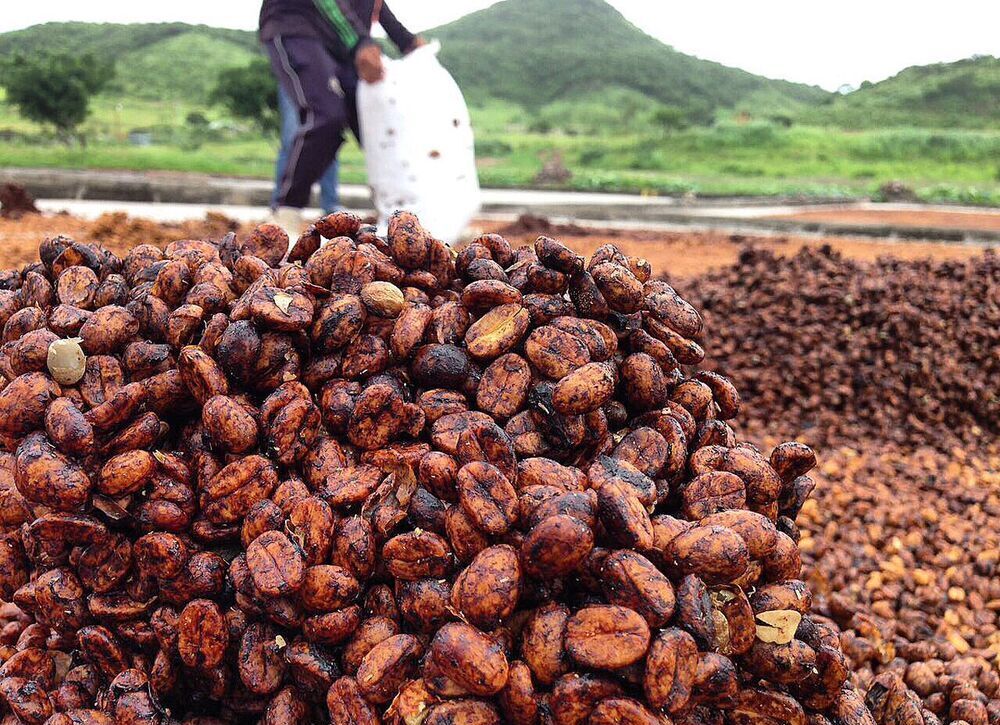
The pulp is removed but the coffee is dried with a set proportion of the mucilage left on. It is classified by the amount of mucilage retained (i.e. by colour).
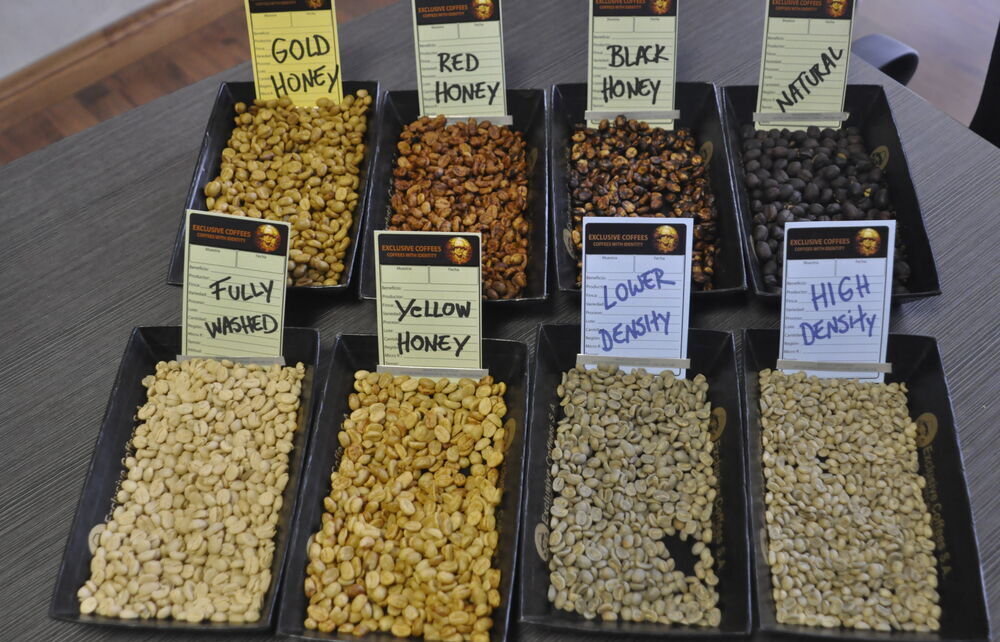
| Process | Acidity | Sweetness | Body | Cleanliness | Defect risk |
|---|---|---|---|---|---|
| Washed | ↑↑ | ↑ | ↓ | ↑↑ | Low |
| Honey | ↑ | ↑↑ | ↑ | ↑ | Medium |
| Natural | ↓ | ↑↑ | ↑↑ | ↓ | High |
"Washed is the process that leaves mucilage on" — false. The process that leaves mucilage is Honey. "Natural gives the cleanest cup" — false. Cleanliness tends to be strongest in Washed.
Experimental — experimental processing
Recent specialty practice controls fermentation precisely to create new flavours. The common principle is to control oxygen, micro-organisms, temperature and time in order to induce fermentation products (esters, acids, alcohols) deliberately.
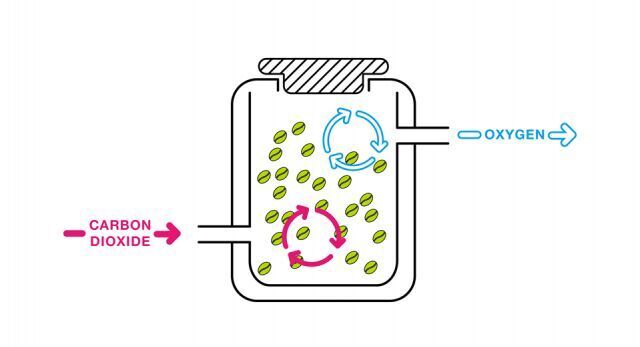
- Anaerobic fermentation — cherries or parchment are placed in a sealed tank and fermented with oxygen excluded by CO₂. Specific micro-organisms dominate, producing intense fruit and fermentation aromas (strawberry, tropical, cinnamon).
- Carbonic maceration — a technique borrowed from winemaking. Whole cherries are placed in a sealed vessel charged with CO₂ to induce intracellular enzymatic fermentation. Bright, distinctive aromatics.
- Others — Double Washed, Wet-Hulled (Sumatran Giling Basah), yeast or culture inoculation, Thermal Shock, Alma Negra and so on.
① Cupping experimental processing. In "Colombia, Pink Bourbon, Anaerobic Natural", the processing leads the flavour more than the origin does. When you cannot tell whether a strong fermented aroma (rum, cinnamon, overripe fruit) is a defect or an intention, note it on the cupping form as "processing-derived fermentation character" and use whether cleanliness, balance and a pleasant aftertaste are maintained as the criterion for assessment.
② Using processing to compensate for a weakness. If a green coffee has good acidity but thin sweetness and body, choose a Honey or Natural lot from the same farm to reinforce sweetness and body with mucilage sugar. Conversely, if excessive fruit aroma makes it muddy, take a Washed lot to secure transparency — the choice of processing is itself profile design.
③ Communicating in sales. If a customer buying a Natural lot says "the fermented smell is odd", explain through the label or a cue card that this is a characteristic of the processing, not a defect ("ripe strawberry, wine nuances"). Knowing the processing lets you set expectations in advance and reduce complaints.
Understanding the market — how coffee is traded
The price of a cup, and its sustainability, begin with the structure of the trade. Only by knowing how coffee is priced and where the money flows can you understand why specialty takes a different route.
How coffee is traded — the C market
The C market (C-Price) is the international benchmark price for Washed Arabica futures traded on the ICE exchange in New York. It is quoted in US cents per pound (lb) and serves as the benchmark for commercial coffee prices worldwide. (Robusta trades as a separate futures contract in London.)
The C-Price does not reflect the cost of production. Driven by speculation, exchange rates and the crop in a large origin (Brazil), it repeatedly forces many smallholders to sell below their cost of production. That structural instability causes farmers to leave coffee, quality to fall and generational succession to break.
The origin and quality premium added to or subtracted from the benchmark (C). Good quality and scarce origins take a (+), lower grades a (−). In the commercial segment, however, that spread is small, so the reward for improving quality does not return to the farm in sufficient measure.
How much does the C price move domestic green coffee prices — an actual calculation
Let us follow in numbers how far the news that "the C market has risen" actually raises the cost base of my roastery. Taking Brazilian commercial green coffee (Fine Cup 17/18) as the reference, the calculation compares C = 300 ¢/lb with C = 400 ¢/lb at an exchange rate of KRW 1,500/USD. The two values bracket the actual 2026 market above and below.
The C price is quoted in US cents per pound. Since 1 lb = 0.453592 kg, 1 kg = 2.204623 lb. Therefore USD/kg = (¢/lb ÷ 100) × 2.204623, and multiplying by the exchange rate gives the won figure. One ICE Coffee C futures contract is 37,500 lb, and a 20-foot container normally holds 320 bags of 60 kg = 19,200 kg.
| Step | C = 300 ¢/lb | C = 400 ¢/lb | Note |
|---|---|---|---|
| ① C price → USD/kg | $6.61 | $8.82 | × 2.204623 |
| ② Converted to won (KRW/kg) | 9,921 | 13,228 | × 1,500 |
| ③ Differential (−10 ¢/lb) | −331 | −331 | Commercial normally takes a discount |
| ④ FOB Santos | 9,590 | 12,897 | Price delivered at the port of loading |
| ⑤ Ocean freight and insurance | +270 | +285 | Container cost apportioned |
| ⑥ CIF Busan | 9,860 | 13,182 | On arrival in Korea |
| ⑦ Import duty | 0 | 0 | 0% quota tariff currently applied (base rate is 2%) |
| ⑧ VAT | 0 | 0 | Green coffee is exempt (temporary measure) |
| ⑨ Customs, quarantine, inland transport, storage | +200 | +200 | Per-container costs converted to kg |
| ⑩ Import cost | 10,060 | 13,382 | The cost the importer carries |
| ⑪ Importer margin 15% | +1,509 | +2,007 | On a 60 kg bag / pallet basis |
| ⑫ Landed green coffee, 1 kg | approx. KRW 11,600 | approx. KRW 15,400 | Difference +KRW 3,800 (+33.0%) |
Coffee where the differential is a fixed plus, as in specialty, is a different story. Run the same calculation on a single estate at +60 ¢/lb and it gives KRW 15,600 → 19,700, +26.7% — a buffer appears. The smaller the share of the price taken by the commodity, the less the C market matters. Coffee bought at an outright price, as in auction lots, has zero C sensitivity.
Conversely, a negative differential actually amplifies the swing. A differential of −10 ¢/lb is a fixed subtraction, so it cuts proportionally more when C is low. At a differential of −30 ¢/lb, the final rate of increase exceeds 33.3%. It is counter-intuitive but true that the cheaper the commercial coffee, the greater its percentage volatility.
The real buffer grows the closer you get to the cup. Allowing for a 17% roasting weight loss, the green coffee cost in 1 kg of roasted coffee is KRW 13,900 → 18,500. Divided into 200 g bags that is KRW 2,790 → 3,710 (+920), and since packaging, labour, rent and margin add some KRW 6,000 on top, the retail price becomes KRW 8,800 → 9,700, +10.4%.
For a single Americano (18 g) it is more dramatic still: KRW 251 → 334, i.e. 83 per cup. A 33% rise in the C market arrives as KRW 83 in a cup. Knowing this figure is what lets a discussion of price increases be conducted as arithmetic rather than emotion.
In the calculation above, the confirmed facts are the unit conversions, the ICE contract specification, and the duty and VAT structure for green coffee. Green coffee (HS 0901.11) has a base rate of 2% but is currently subject to a 0% quota tariff, and as an unprocessed foodstuff it is VAT-exempt. That exemption, however, is a temporary measure extended to the end of 2027, not a permanent regime. No FTA is in force with Brazil, so there is no preferential rate. Before importing, always check the current year's quota tariff schedule on the Korean customs law information portal. [to verify]
The estimates are the differential (−10 ¢/lb), ocean freight (assumed US$2,500–4,000 per container), customs and inland costs (₩150–300/kg), and importer margin (15% by pallet / 30% for 20 kg repacks). The differential is broker subscription data with no public quotation, so you must substitute the figures from your own importer's offer sheet to arrive at your own cost.
Specialty trade · direct trade · fair trade
| Model | Price setting | Core purpose | Limits and cautions |
|---|---|---|---|
| Commodity (C-based) | C-Price + small differential | Efficient distribution of volume at standard quality | Price volatility; production cost not reflected |
| Fair Trade | A guaranteed floor price + premium over C | A price floor and support for cooperatives | Certification costs and cooperative membership required; not directly linked to quality |
| Specialty | Premium based on cup quality (80 points+) | Fair reward for quality | Requires infrastructure for quality assessment and transparency |
| Direct Trade | Price negotiated directly between roaster and farm | Relationship, transparency, reinvestment in quality | Not a standard certification — it is the roaster's voluntary definition, so verification is the crux |
Expressions such as "100% fair trade" or "certified direct trade" require the issuing body and certification number to be stated. Direct Trade is not an official certification scheme but a voluntary commitment by the roaster, so asserting it as a "fair trade standard" without grounds risks breaching advertising law. It is safer to build trust with concrete facts — the farm name, the purchase price, a record of visits.
Does climate change really affect coffee farming
The conclusion first: yes, but it is not simple. Coffee grows well only within a narrow band of temperature and rainfall, which makes it particularly vulnerable to climatic variation.
① Rising temperature pushes the suitable growing zone for Arabica further uphill and shrinks the low-altitude growing areas. ② Disrupted rainfall patterns make flowering and ripening irregular. ③ In a warmer climate, pressure from pests and diseases such as coffee leaf rust (la roya) and the coffee berry borer increases.
Disease- and heat-resistant varieties (F1, Sarchimor and the like), agronomic adaptation such as shade and water management, and moving to higher altitude or new origins. Specialty's direct trade and quality premiums connect to sustainability in that they create the funds for farms to reinvest in this adaptation.
The impact of climate change varies widely by origin, variety and altitude. Flat assertions such as "all coffee will soon disappear" are exaggerations. The accurate statement is: "the range of suitable growing conditions is narrowing, variability is increasing, and investment in adaptation is needed".
① Storytelling that justifies the price. Weaving structure (the C market), relationship (direct trade) and adaptation (climate) into a single story — "even when the C market collapsed we bought directly for the third year at a fixed price agreed with the farm, and that premium went into renewing disease-resistant seedlings" — makes the case for both the fairness of the price and its sustainability at the same time.
② Managing cost and risk. Because the C market spikes and collapses, specialty roasters absorb cost swings through annual fixed-price contracts (direct trade) or futures hedging. Buying spot while watching only the C price leaves you exposed to a cost surge in peak season — knowing the structure of the trade lets you set purchase timing and contract type strategically.
③ Avoiding the certification-labelling trap. Expressions such as "100% fair trade" or "certified direct trade" risk breaching advertising law without an issuing body and certification number. Direct Trade is not an official certification, so in marketing, build trust with concrete facts such as the farm name, the purchase price and a record of visits rather than certification wording.
Questions this chapter answers
- What is the difference between Washed and Natural processing?
- The difference is when the mucilage is removed. Washed coffee is pulped, then fermented and rinsed so that almost all the mucilage is stripped away, which lets origin character show through transparently. Natural coffee is dried whole for 15–30 days, so sugars from the fruit migrate into the seed and fruit character, sweetness and body are emphasised. Honey sits between the two, drying with a set proportion of mucilage left on.
- If the C market rises, how much does green coffee cost in Korea?
- Almost the whole move is passed through. For commercial Brazil, a rise from 300 to 400 US cents per pound — 33.3% — takes the landed Korean price from roughly KRW 11,600 to KRW 15,400 per kilo, a rise of 33.0%. Korea currently applies a 0% quota tariff and a VAT exemption on green coffee, and importer margin is charged as a percentage, so there is effectively no buffer.
- Why does higher altitude improve acidity?
- Higher altitude means lower temperatures, so cherries ripen more slowly. A longer maturation lets the seed accumulate more acids and sugars and grow denser, which tends to produce clearer acidity and more complex flavour. Altitude alone does not decide it, though — microclimate, shade and variety act together.
Figures and regulations are verified against a source hierarchy: Tier 1 in-house knowledge base → Tier 2 SCA·WBC and peer-reviewed literature → Tier 3 web. Anything not adequately supported is marked [to verify] in the text.